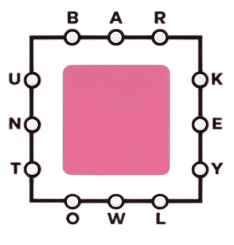
Your Stats
Recent Games
No completed games yet.
🎉 Puzzle Solved!
You solved the puzzle!
Letter Boxed Game: Free Daily and Unlimited Play (2026)
Letter Boxed game look easy the first time you see it. A square, twelve letters, a blank space to type. How hard can it be?
Then you actually play. You find one good word, maybe two. Then everything falls apart. One stubborn letter has no home. Every word you try gets rejected. You reset, start over, and wonder what you missed.
You didn’t miss anything. Letter Boxed just has a few rules that trip everyone up at first. Once those rules click, the whole game changes. This guide covers everything you need to play, solve, and enjoy Letter Boxed whether you are using the free daily puzzle or unlimited mode for practice.
🔲 What Is A Letter Boxed Game?
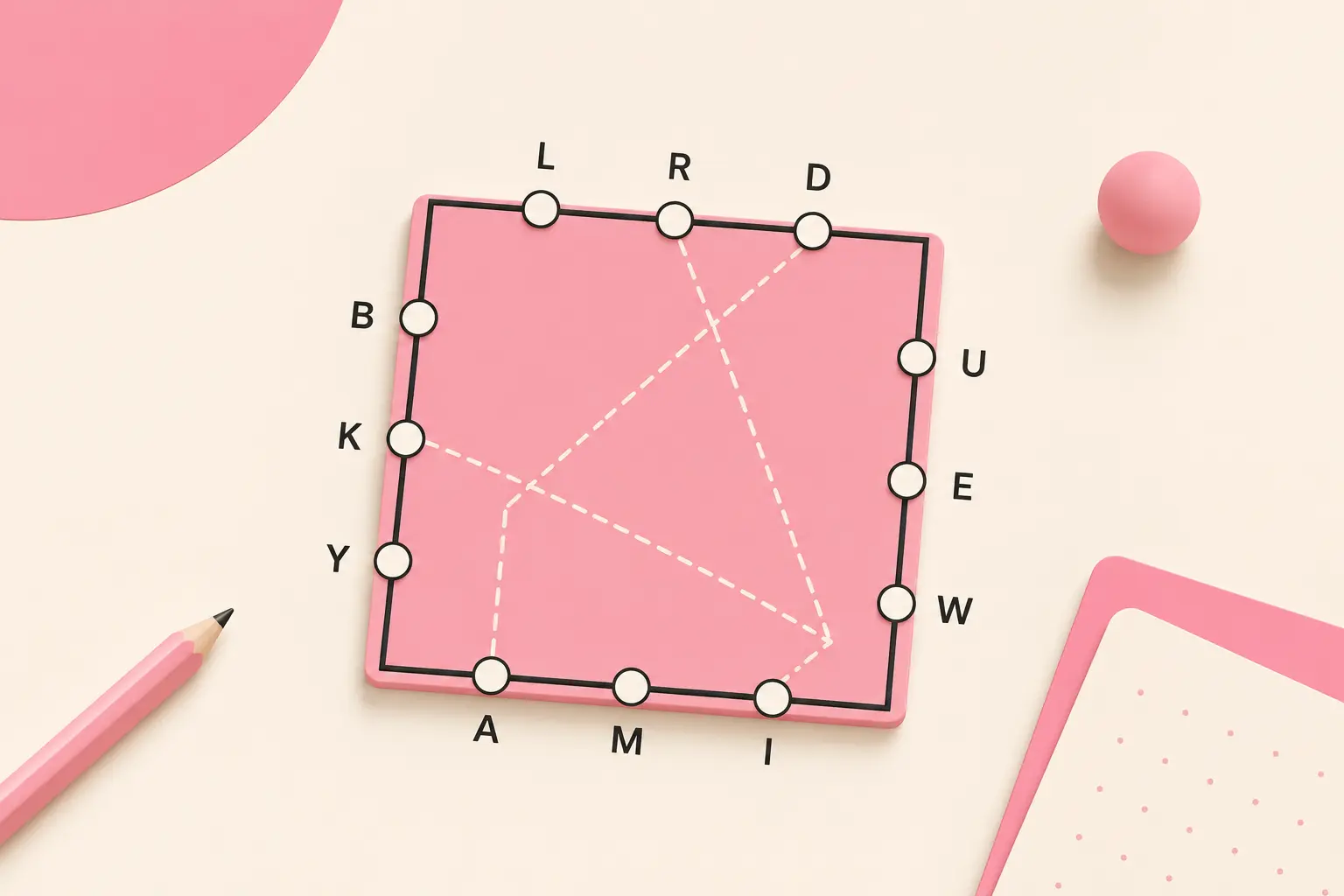
Letter Boxed is a word puzzle built around a square board with twelve letters, three on each side. Your job is to build a chain of connected words that uses every letter at least once.
The game was created by Sam Ezersky, the puzzle editor at The New York Times. It is part of the NYT Games collection alongside Wordle, Spelling Bee, Connections, Strands, and the Crossword. You can play it free daily without an NYT subscription on several platforms.
🎯 What Makes Letter Boxed Different from Other Word Games?
Most word games ask you to guess a word or find words inside a grid. Letter Boxed asks you to build a chain where every word connects to the next and uses letters from across the board.
That mix of chaining and board coverage is what sets it apart from Wordle, Spelling Bee, or a standard crossword. You are not just thinking about one word. You are planning two or three moves ahead, which makes it feel more like a strategy puzzle than a simple vocabulary test.
🧩 How the 12 Letter Square Board Works
The board is a square with four sides. Each side holds exactly three letters. No letter appears on more than one side and no letter repeats anywhere on the board.
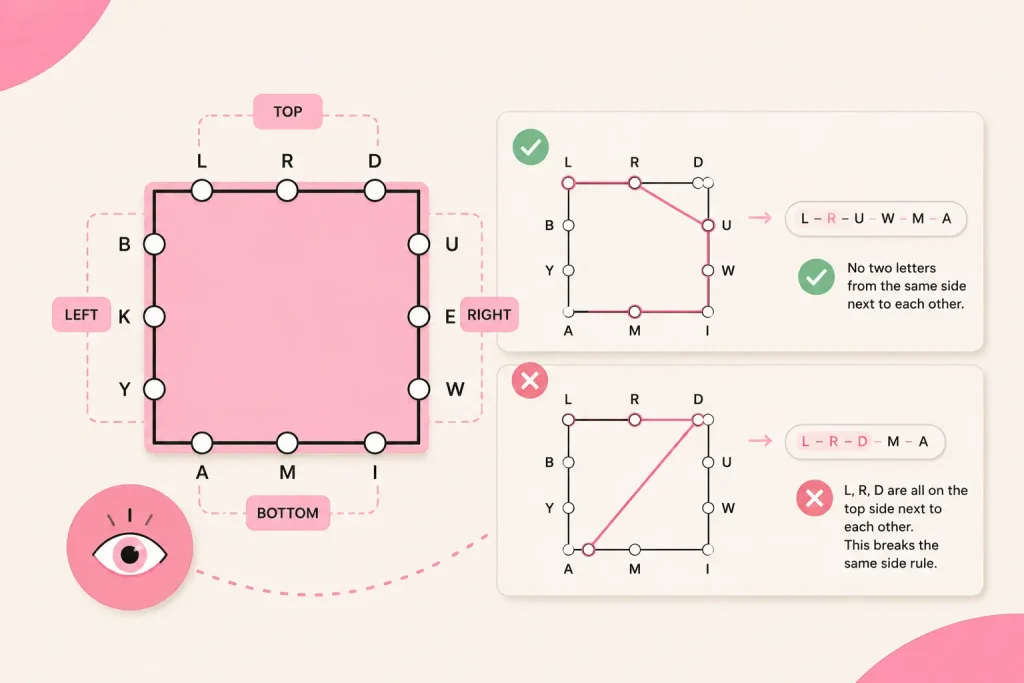
When you pick letters to form a word, each letter must come from a different side than the one before it. If your last letter came from the top, your next letter must come from the left, right, or bottom. Never the same side twice in a row.
This one rule is what makes the game interesting. It stops you from just pulling any word from a dictionary. Every word has to navigate across the board, which forces you to think about letter placement before you type anything.
📖 How to Play Letter Boxed: Complete Rules
The rules take about two minutes to learn. Missing even one of them causes repeated rejections, so read these carefully.
Each word must have at least 3 letters. Two letter words are always rejected.
No two letters in a row can come from the same side of the square.
Each new word must start with the last letter of the previous word in the chain.
You must use all 12 letters at least once across your full chain to complete the puzzle.
Letters can be reused as many times as you need. There is no penalty for revisiting a letter you already used.
Words must exist in the game’s accepted word list, which is a curated dictionary.
🔗 How Word Chaining Works
The chain rule ties the whole puzzle together. Every word must start with the last letter of the word before it. If your first word is PLANT, it ends in T. Your next word must start with T. If that word is TUNNEL, it ends in L. Your third word must start with L. This continues until all 12 letters have been used at least once.
Choosing ending letters carefully is one of the biggest skills in Letter Boxed. Ending on a flexible letter like S, R, T, or C gives you many options. Ending on Q, X, or Z usually traps you with no good next move. If you ever get completely stuck, checking the Letter Boxed answers can help you understand the patterns behind optimal solves.
⚠️ The Same Side Rule Explained
This is the rule that trips up beginners the most. The board shows which side each letter belongs to, but when you are moving quickly it is easy to grab two letters from the same side without noticing.
Build this habit: before submitting any word, scan the sequence and check that no two side by side letters sit on the same side. If they do, the game will reject the word. Not because the word is wrong, but because the path breaks the side rule.
📝 Full Walkthrough: A Complete Solve Example
The best way to understand all the rules at once is to follow a complete example. This uses a sample board, not today’s daily puzzle.
Sample Board:
| Side | Letters |
|---|---|
| 🔼 Top | A, E, T |
| ▶️ Right | N, U, O |
| 🔽 Bottom | C, R, L |
| ◀️ Left | D, P, H |
The Solve:
| Word | Path | Why It Works |
|---|---|---|
| 1. HARD | H (Left) → A (Top) → R (Bottom) → D (Left) | Each letter jumps to a different side. |
| 2. DANCE | D (Left) → A (Top) → N (Right) → C (Bottom) → E (Top) | Starts with D, the last letter of HARD. Chain intact. |
| 3. ERUPT | E (Top) → R (Bottom) → U (Right) → P (Left) → T (Top) | Starts with E, the last letter of DANCE. Covers U and P. |
| 4. TOLD | T (Top) → O (Right) → L (Bottom) → D (Left) | Starts with T, the last letter of ERUPT. Covers O and L, the final unused letters. |
✅ All 12 letters used: A, C, D, E, H, L, N, O, P, R, T, U. Puzzle complete.
💡 Notice that ERUPT was chosen partly because it ends in T, a flexible starting letter that made the final word easy to find. Planning your ending letters is just as important as finding the words themselves.
🏆 What Is a Genius Solve?
Any solution that uses all 12 letters counts as a win. But players measure success by how many words it takes.
| Word Count | What It Means |
| ⭐⭐ 2 words | Genius solve, the best possible result |
| ⭐ 3 words | Strong and efficient |
| ✅ 4 words | Solid completion |
| ✔️ 5+ words | Valid win, but room to improve |
A one word solution would need a single word using all 12 letters while following the side rule. That is almost impossible under normal conditions. For most players, two words is the real target. If the board fights back, three words is still a strong result.
🧠 Letter Boxed Strategy Guide: How to Solve in Fewer Words
Random guessing rarely leads to clean solves. Players who consistently crack Letter Boxed in two or three words follow a structured approach.
Start With the Hardest Letters
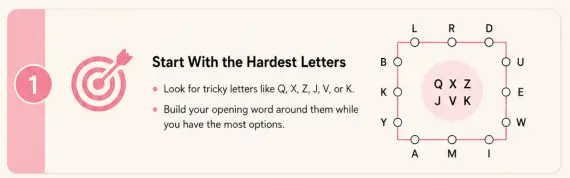
Before typing anything, scan the board for unusual letters like Q, X, Z, J, V, or K. These letters start with very few common words. If you save them for last, you will often find yourself stuck with no valid word to reach them.
Build your opening word around the difficult letter. Use it early when you have the most options and the chain is still flexible.
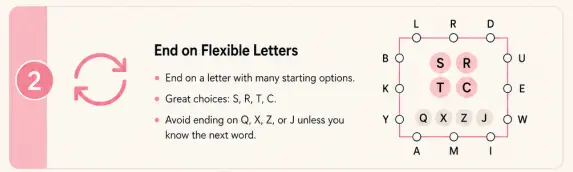
End on Flexible Letters
Some letters start with many more common words than others. Ending your word on one of these gives you the widest choice for your next move.
S works because hundreds of words start with it
R works because the RE prefix alone gives a huge range
T works because TR, TH, and TI combinations are everywhere
C works because CO, COM, and CON are among the most common English prefixes
❌ Avoid ending on Q, X, Z, or J unless you already know exactly what word comes next.
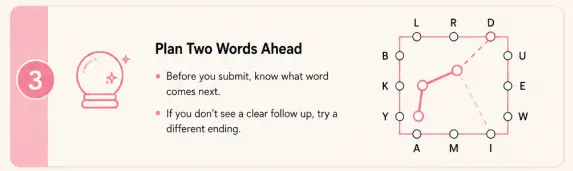
Plan Two Words Ahead
Before submitting any word, ask yourself what word you are setting up next. If the answer is unclear, try a different ending. The habit of not submitting until you can see the follow up move is what separates efficient solvers from frustrated restarters.
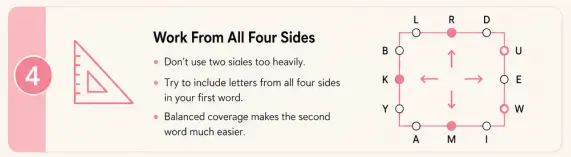
Work From All Four Sides
One of the easiest traps is building a long first word that uses two sides heavily while barely touching the other two. If you reach 8 letters and realize two entire sides are unused, you have painted yourself into a corner.
Try to pull from all four sides in your first word. That balanced coverage makes your second word much easier to find.
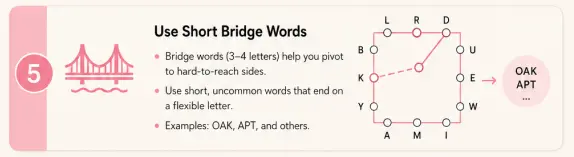
Use Short Bridge Words
A bridge word is a short 3 or 4 letter word you use to pivot between two parts of the board. When your chain stalls because one side is hard to reach, a bridge word connects you to the letters you need.
Good bridge words are short, use uncommon letters, and end on a flexible letter. Words like OAK, APT, and similar short words often save a stalled solve.
❌ Common Mistakes Beginners Make
These errors cause the most resets and frustration. Knowing them early saves a lot of time.
Breaking the same side rule
This is the number one reason words get rejected. You find a real English word, type it in, and it fails because two letters in a row came from the same side. Always trace the path before submitting.
Saving hard letters for last
Players often leave Q, X, or Z for the end because they seem hard to fit. But the longer you wait, the fewer options you have. A chain that is already 8 letters long with an X still unused is in serious trouble.
Ending on dead letters
Ending a word on Q or X means your next word has to start with that letter. Words starting with Q almost always need U next, and U might be on the same side as Q. Words starting with X are extremely rare.
Chasing length over coverage
A ten letter word looks impressive but if it only covers two sides and ends on an awkward letter, it is the wrong choice. A six letter word that touches all four sides and ends on R is far more useful.
Using proper nouns or abbreviations
Names, brands, acronyms, and hyphenated words all get rejected. If a word were capitalized in a sentence, it would not work here.
✅ What Counts as a Valid Word?
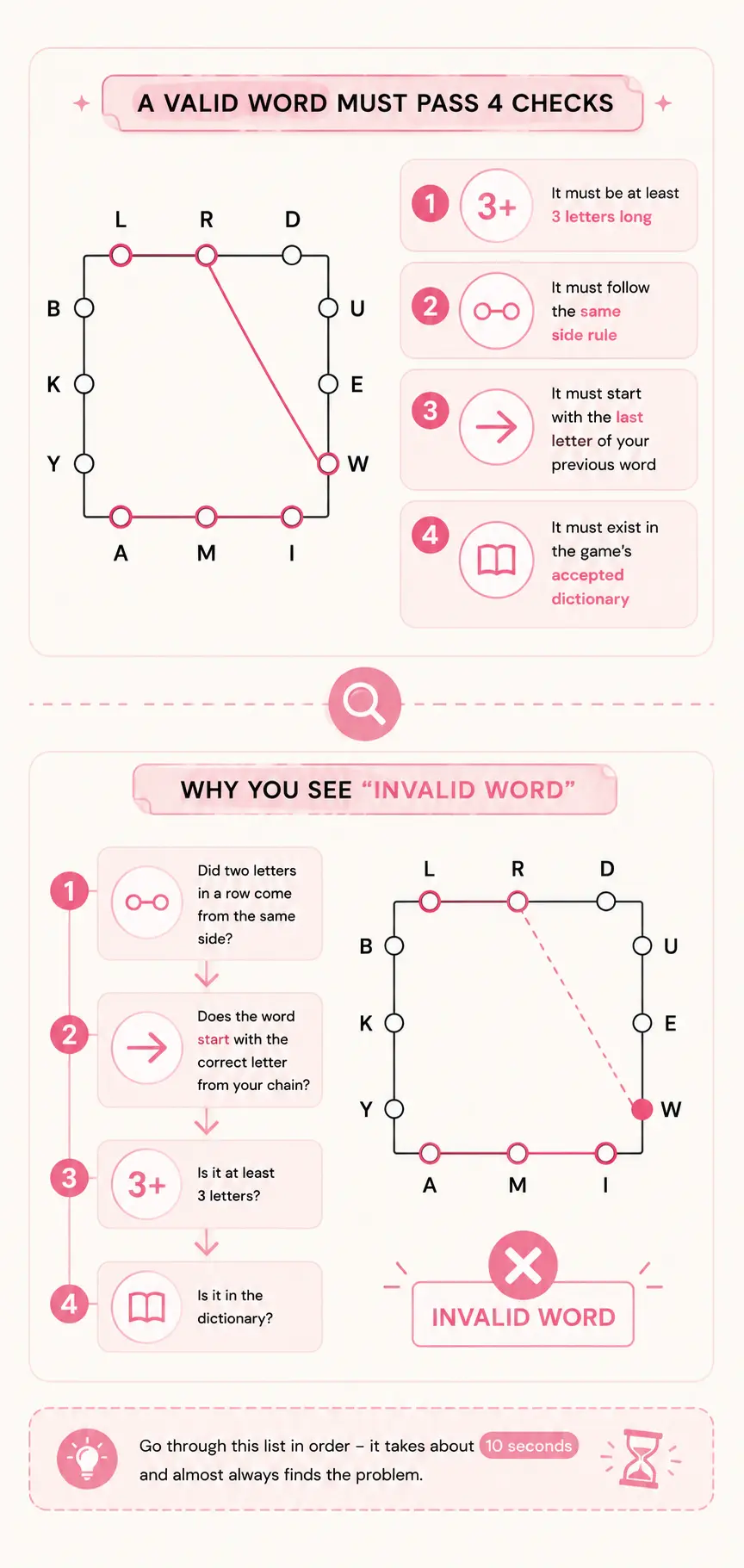
A valid word must pass four checks:
- It must be at least 3 letters long
- It must follow the same side rule
- It must start with the last letter of your previous word
- It must exist in the game’s accepted dictionary
Why You See “Invalid Word”
When a word gets rejected, check these in order:
- Did two letters in a row come from the same side?
- Does the word start with the correct letter from your chain?
- Is it at least 3 letters?
- Is it in the dictionary?
Going through this list takes about ten seconds and almost always finds the problem.
📚 Which Dictionary Does Letter Boxed Game Use?
The daily NYT version uses a curated word list that is deliberately selective. It accepts common English words and a reasonable range of vocabulary but does not include every entry from Merriam Webster or other large dictionaries.
This means some real English words will be rejected. Very old words, highly technical terms, and recent slang often are not included. Different versions of Letter Boxed use different dictionaries, which is why a word might work on one site but fail on another.
🚫 Words That Are Always Rejected
📅 Daily Mode vs Unlimited Mode
Letter Boxed puzzles offer two ways to play and they create very different experiences. If you enjoy this format, you might also want to explore other daily puzzle games that offer a similar one-a-day challenge.
How Daily Mode Works
Daily mode gives you one puzzle per day. Every player worldwide gets the same board, which makes comparison easy. You solve it once, check your word count, and wait for the next day.
The one puzzle per day format creates a routine that keeps players coming back. The mild pressure of having only one shot also improves focus. You think more carefully before submitting when you cannot retry instantly.
How Unlimited Mode Works
Unlimited mode removes the daily limit. Fresh boards appear on demand, giving you the repetition needed to actually improve. If you struggle with certain letter combinations, unlimited mode lets you practice them over and over without waiting 24 hours.
Many players warm up with unlimited mode before the daily puzzle drops. It sharpens pattern recognition so you are ready when the real challenge arrives.
Quick Comparison
| Feature | 📅 Daily Mode | ♾️ Unlimited Mode |
| New Puzzle | Once per day | Anytime |
| Pressure | Higher, one shot | Lower, retry freely |
| Word List | Curated and strict | May vary by version |
| Best For | Daily routine | Skill building and practice |
💡 Daily mode builds the habit. Unlimited mode builds the skill. Using both together is the fastest way to improve.
💰 Do You Need to Pay for Letter Boxed Game?
The official NYT version now requires a paid NYT Games subscription. However, several free versions offer the same format with a fresh daily puzzle and unlimited mode at no cost.
If you just want to play Letter Boxed every day without a subscription, free versions give you full access to daily and unlimited puzzles. The only difference is that the specific board may not match the official NYT board on any given day.
💻How to Play on Desktop and Mobile
Letter Boxed Puzzle works on any modern browser without installation.
Desktop:
Mobile and Tablet:
⚔️ Letter Boxed vs Other NYT Word Games
If you are coming from another word game, here is how Letter Boxed compares so you know what to expect.
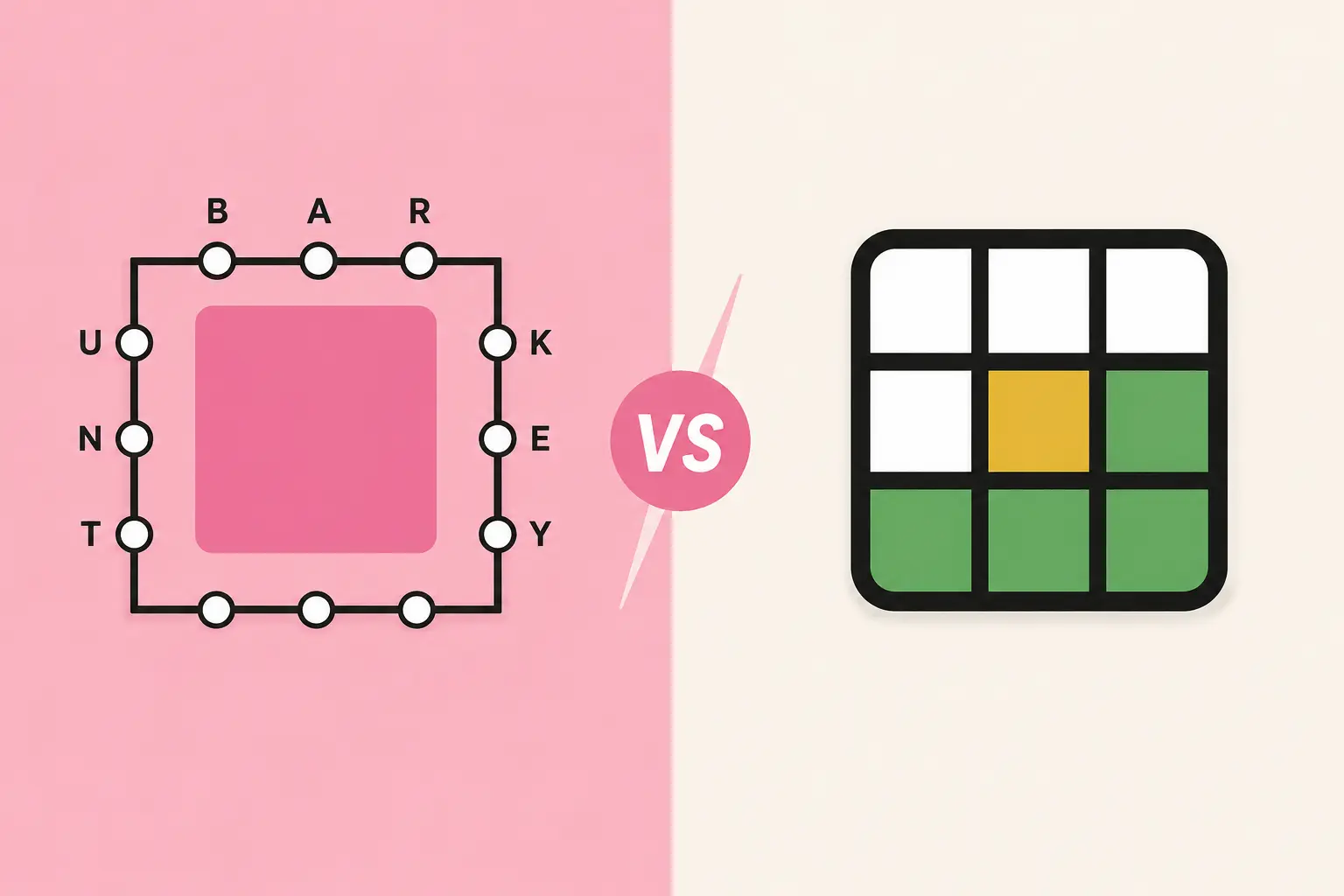
Letter Boxed vs Wordle
Wordle asks you to guess one hidden 5 letter word through the process of elimination. Letter Boxed has no hidden answer. You build your own chain and there are many valid solutions. Wordle rewards deductive reasoning. Letter Boxed rewards planning ahead. For a deeper breakdown, see our full Letter Boxed vs Wordle comparison.
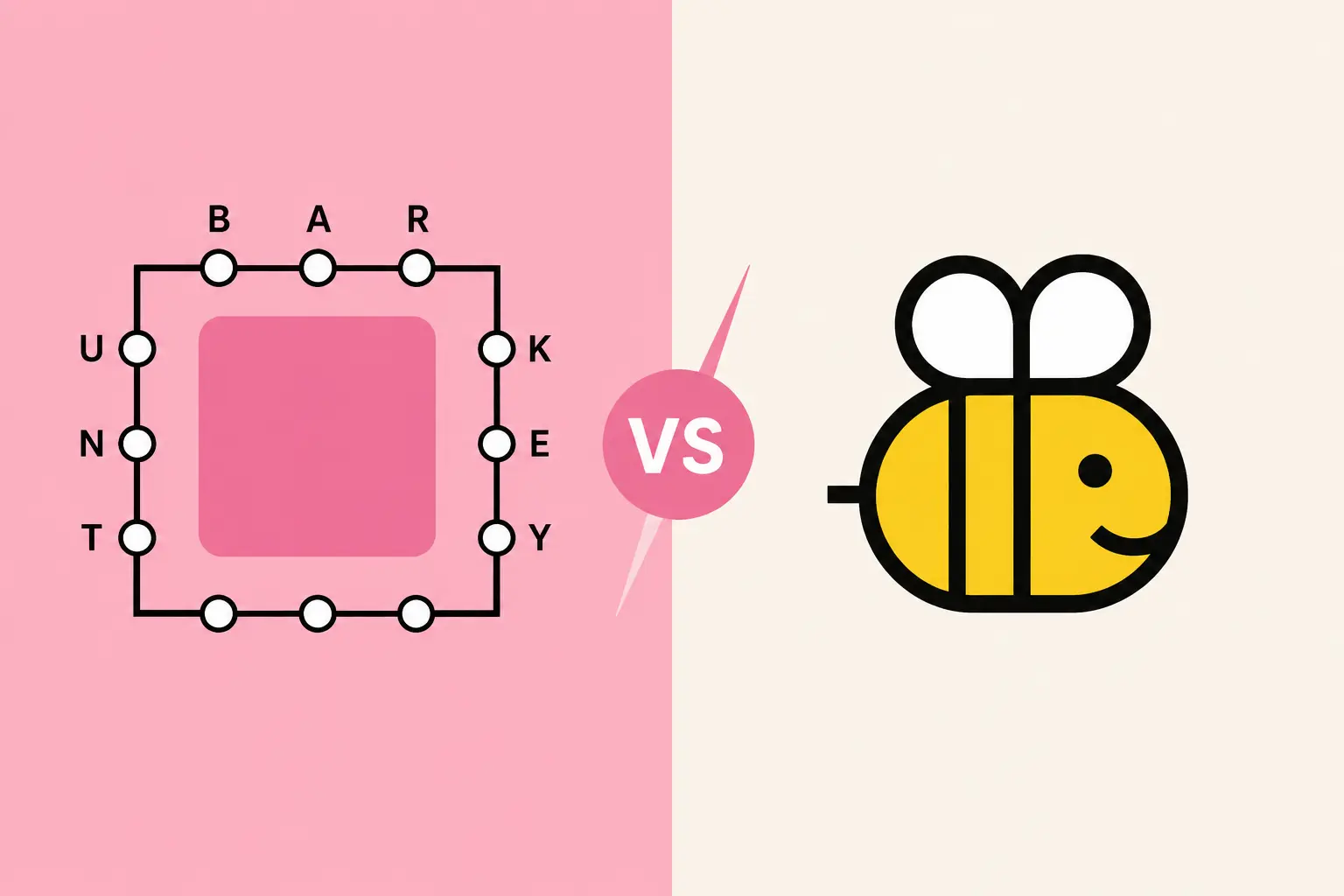
Letter Boxed vs Spelling Bee
Spelling Bee gives you 7 letters and asks you to find as many words as possible. The goal is volume. Letter Boxed is the opposite. The goal is using all 12 letters in as few words as possible. Spelling Bee rewards vocabulary breadth. Letter Boxed rewards strategic depth. You can read more in our detailed Letter Boxed vs Spelling Bee guide.
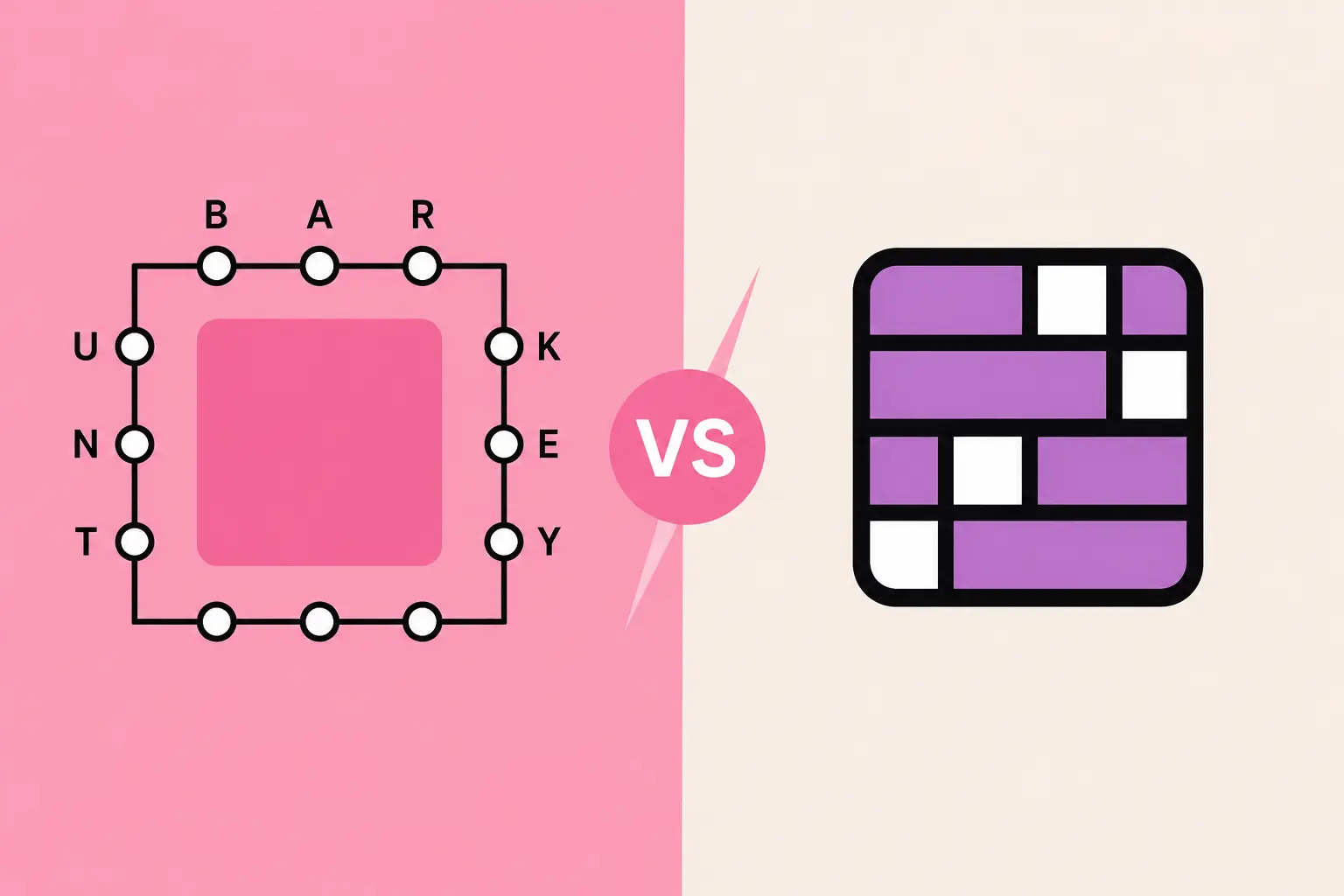
Letter Boxed vs Connections
Connections asks you to sort 16 words into 4 hidden categories. It is a pattern recognition puzzle. Letter Boxed is a construction puzzle where you build the words and design the chain yourself. Very different skills.
Letter Boxed vs Strands
Connections asks you to sort 16 words into 4 hidden categories. It is a pattern recognition puzzle. Letter Boxed is a construction puzzle where you build the words and design the chain yourself. Very different skills.
Letter Boxed vs Crossword
The NYT Crossword is the most vocabulary heavy game in the collection. It tests knowledge through clues and trivia. Letter Boxed requires good vocabulary too but the challenge comes from structural rules and chain building rather than interpreting clues.
👤 Who Is Letter Boxed Best For?
Letter Boxed hits a sweet spot that not every word game reaches. It suits:
- 🧩 Puzzle lovers who enjoy short daily challenges
- 🧠 Word game players who want something more strategic than Wordle
- 🔗 People who like chain based thinking where each decision sets up the next
The learning curve is short. Most players need 3 to 5 puzzles to fully understand the rules. After that the game starts to feel natural. Consistent two word solves usually come after 10 to 20 puzzles of experience depending on vocabulary and strategic instincts.
🔒 Is Letter Boxed Game Safe to Play Online?
The game itself is completely safe. The only risk comes from unknown websites that use the Letter Boxed name but serve aggressive ads, popups, or fake download prompts.
Stay safe by:
- ✅ Checking that the site loads over HTTPS
- ❌ Never downloading any file labeled as a Letter Boxed app from an unofficial source
- ❌ Closing any page that triggers automatic redirects
- ❌ Never entering passwords on unofficial puzzle sites
- ✅ Using trusted app stores if you want the official NYT Games app
Final Thoughts
Letter Boxed game is one of those games that feels impossible the first few times and then suddenly clicks. The same side rule and the chain mechanic create a puzzle that is actually strategic, not just a vocabulary test.
Your action plan:
- Learn the six core rules until they feel automatic
- Build the habit of planning your ending letter before you submit
- Target difficult letters early instead of leaving them for last
- Work toward coverage across all four sides, not just the easy letters
- Use daily mode for your routine and unlimited mode for practice
Once you stop guessing and start planning, the two word genius solution stops being rare and starts being something you expect from yourself.